Few freshwater fish reward patience and precision the way a walleye does. Named for those large, glassy, light-gathering eyes, the walleye is North America’s premier low-light predator. Those eyes contain a reflective layer called the tapetum lucidum, the same tissue that makes a deer’s eyes glow in headlights, and it gives walleye a decisive edge hunting at dawn, dusk, and after dark while their prey is half-blind.
For the intermediate angler, walleye are the perfect next challenge. They are not impossibly hard to catch, but they will not tolerate a sloppy presentation or poor timing. Learn to read structure, slow down, and fish the windows when light is fading, and you will start putting these golden-flanked fish in the boat with real consistency.
Identifying a Walleye
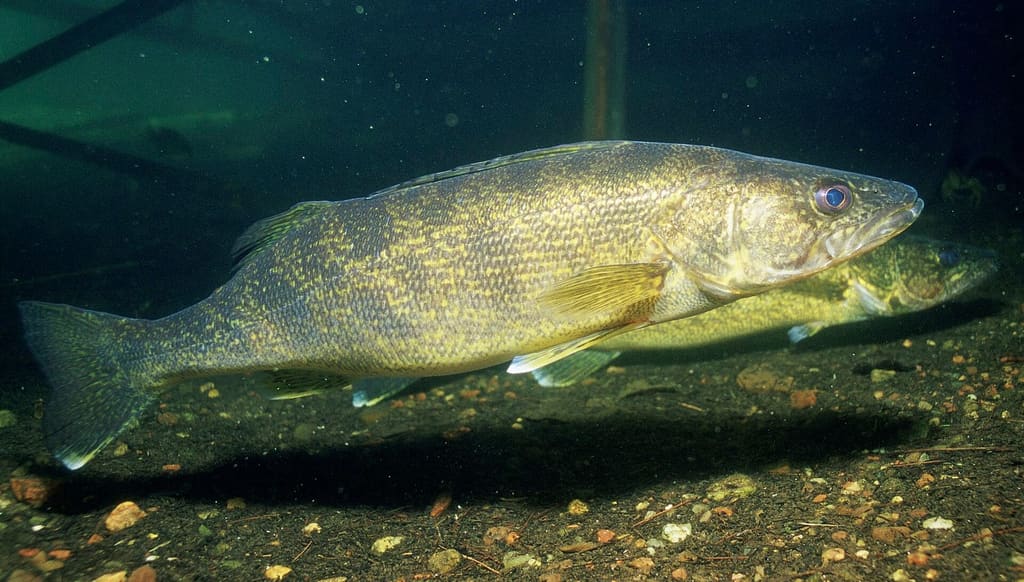
Walleye (Sander vitreus) belong to the perch family, and once you have one in hand the ID is straightforward.
- Olive to gold flanks fading to a white belly, often with a brassy or yellow sheen
- A white or cream tip on the lower lobe of the tail, the single most reliable field mark
- Large, opaque, marble-like eyes that often reflect light
- Two distinct dorsal fins, the front one spiny, and a dark blotch at the rear base of that spiny fin
- A mouth full of sharp canine teeth, unlike its toothless perch cousins
The most common mix-up is with the sauger, a close relative. Saugers have dark saddle-like blotches on the body, a spotted (not clear) spiny dorsal fin, and usually lack the white tail tip. Where their ranges overlap you can even catch a hybrid known as a saugeye, which shows traits of both.
Range and Habitat
Walleye are native across much of central and northern North America, from the Great Lakes and the upper Mississippi basin north into Canada. Decades of stocking have pushed their range well beyond that core, and you can now find them in reservoirs and rivers across much of the United States.
They thrive in:
- Large, cool, clear-to-stained lakes and reservoirs
- Big rivers with current breaks, wing dams, and tailrace areas below dams
- Natural lakes with rock, gravel, and sand structure
The recurring theme is structure plus a comfortable temperature band. Walleye relate to anything that breaks up open water: points, humps, sunken islands, weed edges, rock piles, and the lip where a flat drops into the basin. In clear water they often sit deeper during bright daylight and slide shallow to feed when the light drops.
Diet and Forage
Walleye are ambush and pursuit predators that feed heavily during low-light periods. Their diet shifts with the available forage, but the staples are consistent:
- Yellow perch, where present, are a top target
- Shiners, shad, ciscoes, and other open-water baitfish
- Juvenile panfish and small rough fish
- Crayfish, leeches, and nightcrawlers, especially in summer
Matching the size and profile of the dominant local forage matters more than picking an exotic color. If the lake is full of three-inch perch, a baitfish-profile jerkbait or a perch-pattern crankbait will usually out-fish something flashy and unnatural.
Seasonal Behavior
Understanding the walleye calendar is the difference between random catches and a real pattern.
Spring
As water climbs into the low-to-mid 40s Fahrenheit, walleye run shallow to spawn over rock, gravel, and current. River mouths and dam tailraces concentrate fish, and the pre-spawn and post-spawn windows can offer the best shallow fishing of the year. Many regions close or restrict walleye season during the spawn, so this is the time to be especially careful with regulations.
Summer
After recovering, walleye spread out and relate to deeper structure: main-lake points, humps, and weed edges. They feed hard at dawn and dusk and often go nocturnal in clear lakes. Live bait rigs and trolling shine now as you cover water to find scattered fish.
Fall
Cooling water triggers a heavy feed. Walleye chase baitfish and put on weight before winter, frequently relating to steep breaks and rock. Larger profile baits earn their keep as the biggest fish of the year get aggressive.
Winter
Ice anglers do extremely well on walleye, fishing low-light windows over the same structure. Jigging spoons tipped with a minnow head and dead-stick setups with a lively minnow are the classic one-two punch.
Best Baits and Lures
You do not need a huge arsenal. A handful of proven options covers nearly every situation.
- Jigs and live bait. A 1/8 to 1/4 ounce jig tipped with a minnow, leech, or half a nightcrawler is the foundational walleye presentation. Drag and lift it slowly along bottom.
- Live bait rigs. A slip-sinker or Lindy-style rig with a leech or crawler lets you present bait naturally to neutral fish on deep structure.
- Crankbaits. Shad- and perch-pattern crankbaits cover water on points and flats, and they troll beautifully along breaklines.
- Jerkbaits. Suspending jerkbaits worked with long pauses are deadly in cold, clear water, especially spring and fall.
- Bottom bouncers with spinner harnesses. A nightcrawler harness behind a bottom bouncer is one of the most productive summer trolling setups ever devised.
Techniques That Catch Walleye
- Vertical jigging over schooled fish on humps and river holes, keeping your line straight down and feeling for the subtle tick of a bite.
- Trolling crankbaits or harnesses to locate active fish across flats and along breaklines, then noting depth and speed when you connect.
- Slip-bobber fishing a leech or minnow over a rock pile or weed edge, a quiet, deadly tactic for spooky shallow fish.
- Casting jerkbaits to shallow rock and current breaks during low light.
Two habits separate consistent walleye anglers from the rest. First, fish the low-light windows hard. The hour around sunrise and sunset, plus full darkness in clear lakes, produces a large share of quality fish. Second, learn to detect the bite. Walleye often inhale a jig and swim toward you, so a bite frequently feels like nothing more than your line going slack or weightless. When in doubt, reel down and set.
Size and Records
A typical “good” walleye runs 15 to 22 inches and a pound or two up to maybe four pounds, which is excellent eating size. Fish over 24 to 26 inches are genuine trophies in most waters, and a 10-pound walleye is the fish of a lifetime for most anglers. The longstanding world record, caught in Tennessee in the 1960s, weighed around 25 pounds, a figure that has stood for decades and that many experts treat with healthy skepticism. Realistically, set your trophy bar around the 28-inch or 8-to-10-pound mark and you will have something to be proud of.
Final Thoughts
The walleye rewards anglers who think like the fish: slow down, respect structure, and fish when the light is low. Master those fundamentals with a jig and a minnow before branching into trolling and live bait rigs, and you will build the kind of confidence that turns occasional luck into a repeatable pattern. Few fish are as satisfying to figure out, and even fewer are as good on the plate at the end of the day.