There is an old rhyme that has outlived its usefulness: wind from the west, fish bite best; wind from the east, fish bite least. Anglers have repeated it for generations, and plenty still plan trips around it.
It is not exactly wrong, but it is right for the wrong reason — and if you understand the actual mechanism, you get something far more useful than a rhyme. Wind is arguably the most actionable weather variable on the water, because unlike pressure or temperature, you can see it and immediately act on it. The wind tells you which bank to fish, and that decision matters more than almost any lure choice you will make.
What the Old Rhyme Gets Right and Wrong
In much of the northern hemisphere’s mid-latitudes, weather systems generally track west to east. That means a westerly wind often accompanies a settled or improving pattern, while an easterly wind frequently shows up on the back side of a departing high or ahead of certain frontal setups — conditions that tend to correlate with tougher fishing.
So the rhyme is a crude proxy for pressure trends and frontal position. The fish are not responding to compass direction. They are responding to the weather system that happens to be producing that wind direction.
This matters practically for two reasons:
- It varies by region. Coastal areas, mountain valleys and large lakes with their own local wind patterns break the correlation entirely. An east wind on one lake means something different than on another.
- The direction is far less important than the effect. Where the wind is blowing to on your specific lake will do more for your day than which compass point it came from.
Why Windblown Banks Hold Fish
Here is the mechanism that actually matters, and it starts at the bottom of the food chain.
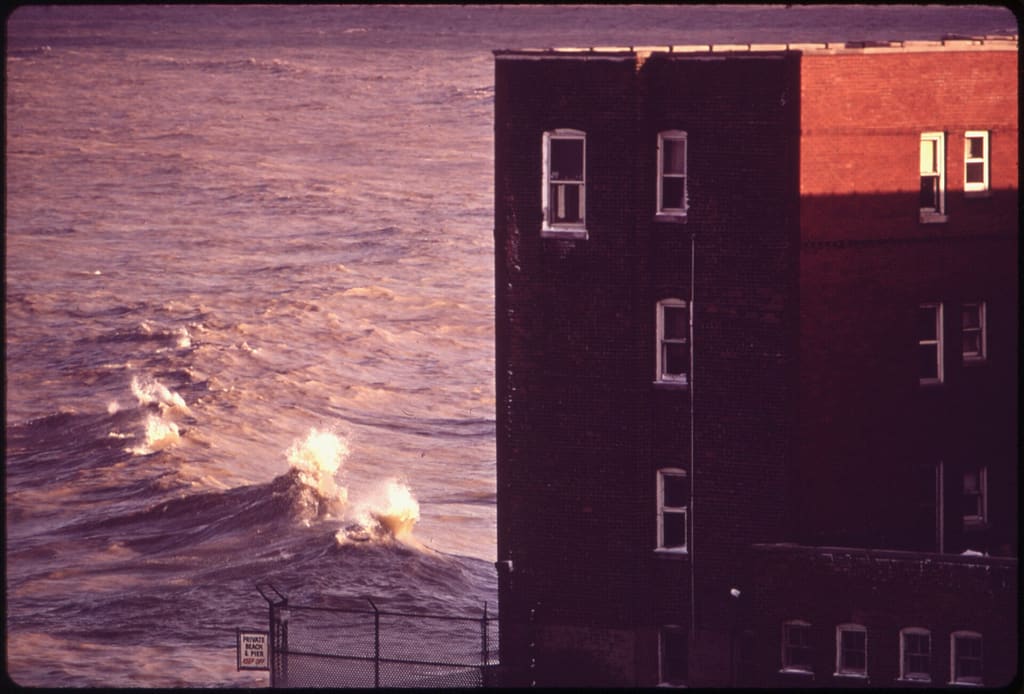
Wind pushes surface water across the lake. That water carries plankton — microscopic drifting organisms that cannot swim against a current — and piles it up against the downwind shore. Baitfish that eat plankton follow the concentration. Predators that eat baitfish follow the baitfish.
Wind also does three other useful things:
It breaks up the surface. Chop scatters light, reducing penetration and making fish bolder and less wary. It also hides your boat, your line and your movement. The “walleye chop” has a name for a reason, and the same principle helps bass, stripers and most sight-feeding predators.
It stirs the bottom. Along a windblown bank, wave action suspends sediment, dislodges invertebrates and creates turbidity. That murk is cover, and predators use it.
It oxygenates. Wave action mixes air into the water, which matters most in hot weather when oxygen is at a premium.
The practical rule is simple and it is worth more than the rhyme: fish the bank the wind is blowing into. The windward shore — the one taking waves — usually holds the food and the fish. The calm, sheltered lee shore looks more inviting and usually fishes worse.
Fishing Mud Lines
On a windblown bank, wave action stirs up a visible band of turbid water along the shore. Where that stirred water meets cleaner water, you get a mud line — a distinct edge you can see from the boat.
Mud lines are ambush walls. Predators sit just inside the murky side, or right on the seam, and pick off baitfish that stray across. The dirty water hides the predator and blinds the prey. Fish it like structure:
- Cast parallel to the line rather than across it, keeping your bait in the strike zone longer.
- Work the clean side first, then the seam, then inside the murk.
- Focus on where the mud line intersects something else — a point, a rock pile, a dock, a laydown. That intersection is the best cast on the bank.
Mud lines are most pronounced on shallow, soft-bottomed windblown banks and after several hours of sustained wind. They can take a while to set up, so a bank that looked plain in the morning may be excellent by afternoon.
Casting Into the Wind vs. With It
There is a real tradeoff here and no single right answer.
Casting with the wind gives you distance, keeps your line from bowing badly, and is simply easier. The cost is that you often present the bait moving in an unnatural direction relative to the current the wind has set up, and you may spook fish by approaching from upwind.
Casting into the wind costs you distance and creates line management problems, but it lets your bait move with the wind-driven current, which is how forage actually moves. It also keeps your boat downwind of the fish. On a hard windblown bank, presenting with the natural flow frequently outproduces casting downwind.
Practical adjustments for wind casting:
- Use heavier baits than you otherwise would — a half-ounce spinnerbait cuts wind that a quarter-ounce cannot.
- Keep your rod tip low on the cast and low on the retrieve to stay under the worst of it.
- Accept a shorter cast made accurately over a long cast that lands anywhere.
- Watch for slack line. A wind bow between rod and lure kills hooksets. Reel down and keep contact.
- Braided line cuts wind better than mono and telegraphs bites through a bow more reliably.
Boat Control in Wind
Wind is the main reason a windblown bank goes unfished, and boat control is usually the limiting factor.
- Bow into the wind and use the trolling motor to hold position. You have far more control fighting the wind than running with it.
- Use a drift sock on open water. Slowing the drift from too-fast to just-right transforms a wind day from unfishable to productive.
- Spot-lock or anchor when you find a concentration. On a mud line intersection or a windblown point, holding position beats drifting past repeatedly.
- Plan your drift so the wind carries you across the structure rather than off it, and reset upwind.
From the bank, the same logic applies in reverse: you have the advantage on windblown shores because you can stand on them, and the anglers in boats often will not come to you.
How Wind Interacts With Fronts
Wind direction is most informative when you read it as part of a frontal cycle rather than in isolation.
- South or southwest wind, building, with rising humidity: typically ahead of an approaching front. Falling pressure, building clouds. This is often the best fishing of the week.
- Strong shifting wind with storms: the front passing. Fishing can be good until it becomes unsafe. Leave early.
- North or northwest wind, dry, with clearing skies: post-frontal. Pressure rising, bluebird sky, tough conditions. See our guide on fishing a cold front for how to salvage these days.
- Light and variable wind, stable for days: a settled high. Predictable but often unremarkable fishing, with dawn and dusk carrying more of the load.
Read this way, the direction of the wind is a diagnostic clue about where you are in the weather cycle — which is exactly what the old rhyme was fumbling toward, several centuries before barometers were common.
Wind also interacts with dead calm. A flat calm day is not neutral, it is a distinct condition: high light penetration, spooky fish, and a need for longer casts, lighter line and subtler presentations. If you have been struggling on calm water, why fish aren’t biting walks through the wider troubleshooting sequence.
Common Questions
Does wind direction really matter for fishing?
Less than the old rhyme suggests. Wind direction matters mainly as an indicator of where you are in a weather cycle — southerly winds often precede a front and coincide with good fishing, northerly winds often follow one and coincide with tough fishing. But the direct effect on fish comes from what the wind physically does to the water: pushing plankton and bait onto the downwind shore, breaking up the surface, and stirring sediment. That effect is far more actionable than the compass reading.
Which side of the lake should I fish in the wind?
Fish the bank the wind is blowing into — the windward or downwind shore that is taking waves. Wind pushes plankton against that shore, baitfish follow the plankton, and predators follow the baitfish. The sheltered calm bank looks more pleasant to fish and usually holds fewer active fish. The main exception is safety: if the windward bank is unfishable or unsafe to approach, fish a protected area rather than risk it.
Is it worth fishing on a very windy day?
Often yes, up to a safety limit. Moderate wind is frequently better than calm because it reduces light penetration, makes fish less wary and concentrates food. The practical constraints are boat control and casting accuracy, both of which can be managed with heavier baits, a drift sock and bowing into the wind. Once you have whitecaps and a small boat on open water, the answer flips — fish a protected pocket or wait it out.
What is a mud line and how do I fish it?
A mud line is the visible edge where wave-stirred, sediment-laden water along a windblown bank meets cleaner water further out. Predators use the murky side as cover and ambush baitfish crossing the seam. Fish it by casting parallel to the line rather than across it, covering the clean side and the seam before working into the murk, and concentrating on any point where the mud line intersects other structure like a point, rock pile or laydown.
Final Thoughts
Wind is the one weather variable you can act on the moment you step out of the truck. You do not need an app, a barometer or a forecast — you just need to look at the water and see which bank is taking the waves.
Then go fish it, uncomfortable as that may be. Use heavier baits, keep contact with your line, control your boat, and hunt the mud lines. The bank everyone else avoids because the casting is hard is usually the one where the food chain has stacked up all afternoon.