Almost every problem an angler has with a fly rod comes back to the overhead cast. It is the foundation move, the one you build mending, reach casts, and roll casts on top of. Get it clean and consistent, and a sloppy day on the water turns into a good one. The good news for an intermediate caster is that the overhead cast is not about strength or fancy wrist work. It is about timing, a stopped rod tip, and trusting the line to do the work.
If your loops have been opening up, your line has been piling at your feet, or you keep hearing that whip-crack that means a broken-off fly, this is the cast to slow down and rebuild. Below is a step-by-step breakdown you can drill on the lawn before you ever wade in.
How the Overhead Cast Actually Works
The overhead cast works because a fly line has mass. Unlike spin fishing, where a weighted lure pulls light line off the reel, in fly fishing the line itself is the weight you are casting. The fly is just along for the ride.
You load the rod by accelerating the line behind you (the backcast), let it straighten, then accelerate it forward (the forward cast) and stop the rod crisply so the line unrolls toward the target. That stop is the single most important thing you will do. A clean stop forms a tight, energy-efficient loop. A trailing, mushy stop dumps energy and opens the loop.
Two principles do most of the work:
- The rod tip travels in a straight line, not an arc, during the casting stroke.
- You accelerate smoothly to a hard, abrupt stop, rather than throwing with constant power.
The Casting Arc and the Clock Face
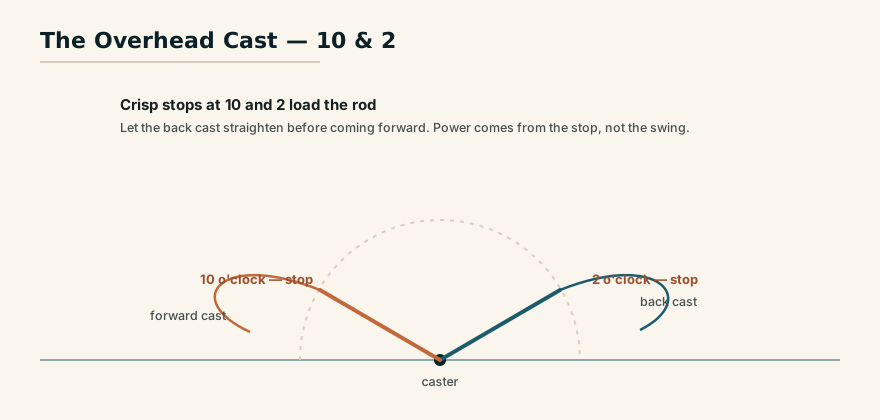
Most instructors teach the stroke using a clock face, with you standing sideways to it. Your rod stops at roughly 10 o’clock on the forward cast and 1 o’clock (or just past) on the backcast. The space between those two stops is your casting arc.
The key insight is that the arc should be short for short casts and wider for long casts. Beginners tend to use one giant arc for everything, dropping the rod tip too far back toward 3 o’clock. That low backcast is the most common reason loops collapse and line slaps the water behind you.
Setting Up: Grip, Stance, and Starting Position
Before the first stroke, get your platform right.
- Grip the cork with your thumb on top, pointing toward the target. The thumb-on-top grip gives you a firm stop and keeps the rod tracking straight.
- Stand with your feet shoulder-width apart. A slightly bladed stance, with your casting-side foot back, lets you watch your backcast without twisting.
- Strip 20 to 30 feet of line off the reel and get it out past the rod tip. You cannot make a good cast with the leader hanging at your guides. Roll-cast or lob it out first to get working line in the air.
- Lower the rod tip to the water and remove any slack. The cast starts with a straight line and a low tip, not with the rod already raised.
Slack line is a silent killer. If there is a belly of loose line between the rod tip and the water, your first move just takes up that slack instead of loading the rod.
The Backcast
The backcast deserves equal respect with the forward cast. A bad backcast cannot be saved on the way forward.
- Start with the rod tip low and accelerate smoothly upward and back, like you are flicking paint off a brush.
- Keep the acceleration building, then stop the rod crisply at about 1 o’clock. Do not drift the rod down behind you.
- Let the line straighten out behind you before you begin the forward cast. This is the pause that beats most casters.
- Turn your head and watch the backcast unroll until you have learned the timing by feel.
The pause is not a fixed count. More line in the air means a longer pause. Watching the loop unroll teaches you to feel the moment the line straightens and gently tugs the rod tip, which is your cue to come forward.
The Forward Cast and the Stop
Once the line has straightened behind you, drive forward.
- Accelerate the rod forward smoothly, with your forearm leading and only a small amount of wrist at the end.
- Stop the rod hard at about 10 o’clock. Imagine throwing a dart, or hammering a nail into a wall in front of you.
- After the stop, let the rod tip drift down to follow the line to the target. This is the follow-through, and it happens after the loop has formed, not during it.
The fly line will roll out in a loop above the path your rod tip traveled. If you stopped high and crisp, the loop is tight and turns over with authority. If you pushed through the stop or let the tip drop, the loop opens and the fly lands in a heap.
Common Faults and Quick Fixes
- Tailing loops and wind knots: usually too much power applied too early, or a jerky stroke. Smooth out the acceleration.
- Line piling up short: weak or absent stop on the forward cast. Make the stop more abrupt.
- Wide, lazy loops: the rod tip traveled in an arc instead of a straight line. Keep the stroke compact and the tip tracking flat.
- Cracking and broken flies: backcast started too soon. Lengthen the pause.
Drills to Groove the Cast
You learn casting on grass, not on fish. Lay out a target hoop or a hat at 30 feet and practice with just the leader and a small piece of yarn instead of a hook.
- Practice false casting, the act of keeping the line in the air with repeated backcasts and forward casts, to feel the timing without shooting line. Limit yourself to one or two false casts on the water; more than that just spooks fish and risks tangles.
- Drill the stop alone. Make ten casts where you exaggerate the abrupt stop at both ends. Feel the difference in the loop.
- Cast with your eyes on the backcast for a full session so the pause becomes automatic.
Final Thoughts
The basic overhead cast rewards patience over power every single time. Build it on a smooth acceleration, a straight-line rod tip, a crisp stop, and a backcast pause you have learned to trust. Drill those four things on the lawn until they feel boring, and they will hold together when a fish is rising and your heart rate is not. Once this cast is solid, every other technique in fly fishing becomes a small variation on a move you already own.