Fishing gear rarely fails suddenly. It fails gradually, and then it fails at the worst possible moment - a drag that grinds instead of slipping, a guide insert that cuts your line, a reel handle that binds mid-fight. Almost all of it is preventable, and the prevention takes about ten minutes a trip.
The economics are hard to argue with. A decent reel is a meaningful purchase, and a well-maintained one lasts a decade or more of hard use. A neglected one, especially in salt water, can be scrap in two seasons. This guide covers what to do after every trip, what to do a few times a year, and what to do before your gear goes into storage.
After Every Saltwater Trip: Rinse
Salt water is the single most destructive thing your gear encounters. Salt crystallizes as water evaporates, and those crystals sit in bearings, on the drag stack, in guide frames, and inside the reel body drawing moisture out of the air. Corrosion continues long after the reel looks dry.
Rinse before you do anything else, and rinse correctly:
- Use a light spray or gentle stream of fresh water. Never a pressure washer or a hose on jet setting. High-pressure water drives salt past seals into the internals - the exact opposite of what you want.
- Tighten the drag fully before rinsing. A tight drag compresses the washer stack and reduces the path water can take into it. Back it off again once the reel is dry.
- Rinse the whole rod too. Guides, the reel seat, and the ferrule joint on multi-piece rods all trap salt. The reel seat threads are a classic spot for a seized reel foot.
- Wipe down and air dry somewhere shaded with airflow. Don’t leave gear in direct sun or in a sealed rod locker while wet.
- Work the reel a few turns while rinsing to move water past external surfaces, then dry.
Fresh water fishing is far gentler, but a wipe-down after a trip still pays. Sand, silt, and weed fragments are abrasive, and they find bearings just as readily as salt does.
Lubrication: Where and What
Over-lubricating is as common a mistake as never lubricating. Excess oil attracts grit and turns into a grinding paste; grease in the wrong place drags on moving parts. Use a little, in the right spots.
The general rule: oil for anything that spins fast, grease for anything that meshes slowly under load.
Oil Points (Light Reel Oil, One Drop Each)
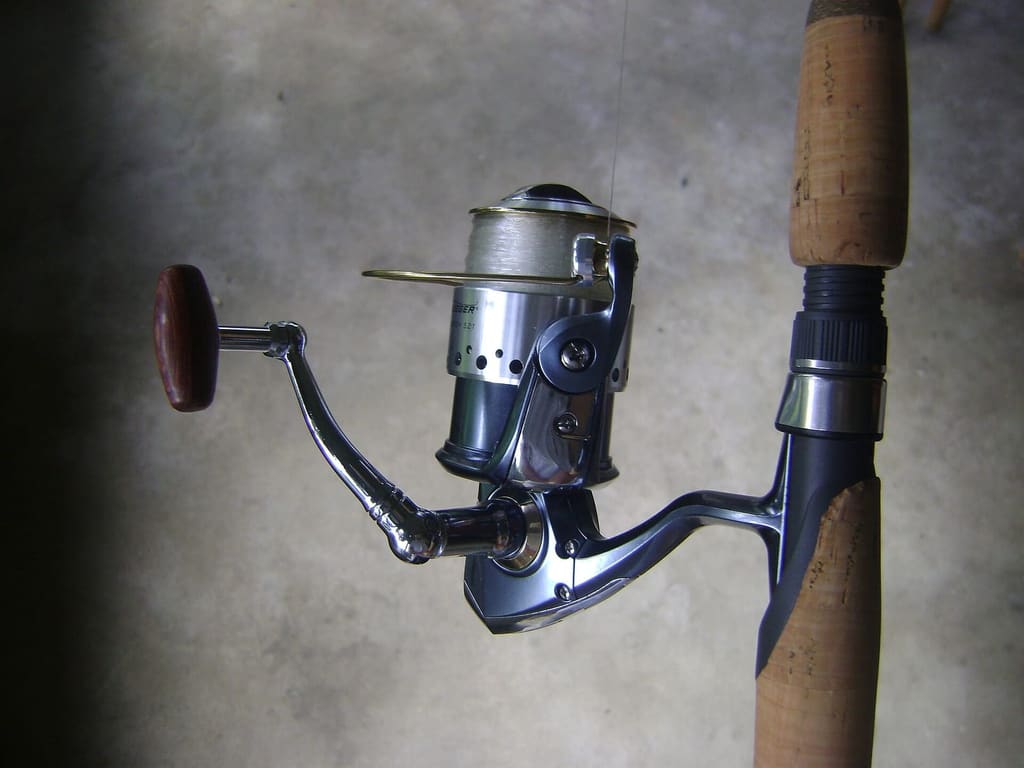
- Handle knob bearings - one drop where the knob meets the shaft, both sides.
- Spool shaft on baitcasters - a single drop, then work it in. This is the highest-impact lubrication point for casting performance.
- Bail arm pivot points on spinning reels.
- Line roller on spinning reels. Critically important and widely neglected - a seized line roller is a major cause of line twist.
- Level wind worm gear on baitcasters.
Grease Points (Reel Grease, Thin Film)
- Main gear and pinion teeth - a thin coat, not a packing.
- Drive shaft and the oscillation mechanism.
- Reel seat threads and the reel foot - a very light smear prevents galvanic seizing, especially in salt.
The Drag Stack
Drag washers are the one place where “more lubricant” is often actively wrong. Different washer materials want different treatment - some carbon fiber stacks run best lightly greased with a specific drag grease, some felt stacks want a different treatment, and some are designed to run dry. Greasing a dry-designed stack makes the drag slip inconsistently; running a grease-designed stack dry makes it grabby.
Check your manual. If you don’t have one, the manufacturer’s site usually has a schematic. When in doubt, clean the washers and leave them as you found them rather than adding something.
Line Replacement Intervals
Line is the cheapest part of your setup and the one that loses you fish. There’s no universal interval, but these are reasonable defaults for regular use:
- Monofilament: every season, or twice a season if you fish heavily. Mono degrades from UV exposure and absorbs water over time, losing strength and gaining memory.
- Fluorocarbon: roughly a season. More UV-resistant than mono but stiffens and develops memory with age.
- Braid: two to four seasons or longer. Braid holds up remarkably well. When the outer sections fray or fade, you can often reverse the spool - strip it onto a spare spool and rewind so the fresh inner line is now on the outside, effectively doubling its life.
Replace early, regardless of interval, if you see:
- Fuzzing, fraying, or a chalky surface on mono
- Persistent memory coils that don’t relax under tension
- Discoloration or a section that feels rough between your fingers
- Any break-off you can’t explain by a knot failure
Even on a fresh spool, cut back and retie the last few feet after a hard fight or after fishing rock and timber. That’s where abrasion accumulates. Our guides to fishing line types and braided line cover the material differences in depth.
Inspecting Guides
Rod guides have a metal frame and, on most rods, a ceramic insert ring. A cracked or chipped insert acts like a blade on your line - it will cut through braid in a few casts and slowly weaken mono until it fails on a good fish. This is one of the most common causes of the inexplicable break-off.
Check guides at the start of each season and after any rod takes a knock:
- Look at each insert under good light, turning the rod. Look for chips, cracks, and grooves worn into the ring.
- Run a cotton swab or a nylon stocking around the inside of each ring. Snagged fibers reveal a chip you can’t see.
- Check the frames for corrosion, bending, and loose wraps.
- Check the tip-top most carefully. It takes the most abuse and is the cheapest guide to replace.
A single damaged guide can usually be replaced by a rod shop for a modest cost, or by you if you’re comfortable with thread wraps and finish. Don’t fish a rod with a chipped guide “just for today” - the cost is your next good fish.
Rod Storage
How you store rods matters more than most anglers assume, because the damage happens slowly and invisibly.
Vertical is generally preferred. A rod stored upright in a rack, supported at the butt, carries its own weight evenly along the blank with no lateral load. Standard vertical racks are the simplest good option.
Horizontal works if support is even. Horizontal racks are fine as long as the rod is supported at multiple points along its length. What causes problems is a rod resting on two widely spaced supports with a long unsupported span in the middle - over months, that sustained bend can produce a set in the blank.
What actually ruins rods:
- Heat. A rod left in a hot car, an uninsulated attic, or a closed garage in summer is the fastest way to soften the epoxy in guide wraps and the reel seat adhesive. Guides come loose, reel seats separate. Heat is worse than cold by a wide margin.
- Long-term bending. Storing rods leaned against a wall in a corner, or crammed diagonally into a truck bed, puts a permanent curve into a blank.
- UV. Sunlight through a window degrades epoxy finish and the blank’s resin over years.
- Impact on the tip. The top few inches of a rod are the thinnest and most fragile part. Doorways, ceiling fans, and tailgates account for a remarkable share of rod deaths.
Protecting the tip. Use rod sleeves or socks for transport and storage - they prevent guide-to-guide tangling and cushion the tip. Rod tubes are worth it for travel. Never store a rod with a lure clipped to a guide and tension on the line, which loads the blank continuously.
Two-piece rods should generally be stored separated, with the ferrules clean. A light wipe of the male ferrule keeps it seating properly; avoid heavy lubricants there, which can cause the joint to slip apart under load.
Off-Season Preparation
If your gear sits for months, spend an hour before it goes away:
- Clean everything thoroughly. A final rinse and wipe-down of every rod and reel.
- Back off every drag to nearly free. This is the most important storage step. Drag washers left compressed for months take a permanent set and lose their ability to slip smoothly.
- Strip or loosen old line. Line left under tension on a spool all winter comes out with heavy memory. Either strip it now, or plan to replace it in spring.
- Lubricate lightly at the points listed above. A film of fresh grease on gears protects against slow corrosion.
- Store in a stable environment. A conditioned closet beats an unheated garage or shed. Temperature swings and humidity cycling are what corrode.
- Empty and dry the tackle box. Wet hooks and split rings rust and spread rust to whatever’s beside them. Silica gel packs in the trays help.
- Check the rest of the kit - net mesh for tears, pliers for stiffness, and your license expiry date.
Come spring, a reel that was stored properly needs a quick wipe and fresh line. One that wasn’t needs a service.
Common Questions
How often should I take my reel apart for a full service?
For most anglers, once a year is right - typically at the end of the season, before storage. A full teardown means removing the sideplates, cleaning old grease off the gears with a suitable solvent, inspecting bearings, cleaning the drag stack, and reassembling with fresh lubricant. Heavy saltwater users should service more often, sometimes twice a season, because salt intrusion accelerates everything. If you’re not confident opening a reel, photograph each stage as you go, and remember that many tackle shops offer reel servicing at a reasonable cost - cheaper than replacing a reel you reassembled with a spring left over.
Can I use household oil or lubricant on my fishing reel?
Better not to. General household oils are often too heavy, and multipurpose penetrating sprays are thin solvents designed to free stuck parts - they dissolve and displace the grease that’s supposed to stay on your gears, then evaporate, leaving the reel worse off than before you started. Some are also aggressive toward the plastics and drag washer materials used in modern reels. Dedicated reel oil and reel grease are inexpensive, a bottle lasts years, and they’re formulated for the specific viscosities and materials involved.
Is it really necessary to rinse after freshwater fishing?
It’s not urgent the way saltwater rinsing is, but a wipe-down still pays. Fresh water leaves behind silt, sand, algae, and mineral deposits, and sand in particular is abrasive - it works into bail mechanisms, line rollers, and level winds and grinds away at them. Lake and river water also carries organic matter that dries into a sticky residue. A damp cloth over the reel body and a wipe of the guides after each trip takes under a minute, and it’s the difference between a reel that stays smooth and one that develops that gritty feel after a couple of seasons.
Final Thoughts
Maintenance isn’t a project, it’s a set of small habits: rinse gently after salt, wipe down after fresh water, oil the spinning parts and grease the meshing ones sparingly, replace line before it fails rather than after, and check your guides for chips.
Then store your gear where it’s cool, supported, and unloaded, with the drags backed off. Do that and your rods and reels won’t just survive - they’ll perform the same way in year eight as they did the day you bought them.