There are days on a white bass run when you stop counting. Fish after fish, all roughly the same size, all hitting the same lure, until your forearm gives out before the school does. Few freshwater species deliver that kind of volume, and almost none of them do it from the bank in early spring when nothing else is really cooperating.
White bass do not get much respect, largely because they are not big. A pound and a half is a solid fish, and three pounds is a genuinely good one. But they fight above their weight, they school in enormous numbers, and they are absolutely predictable if you understand two things: when they run up the rivers, and how they push bait to the surface in open water.
This guide covers both, plus how to tell a white bass from the two fish it gets confused with most.
Identifying White Bass
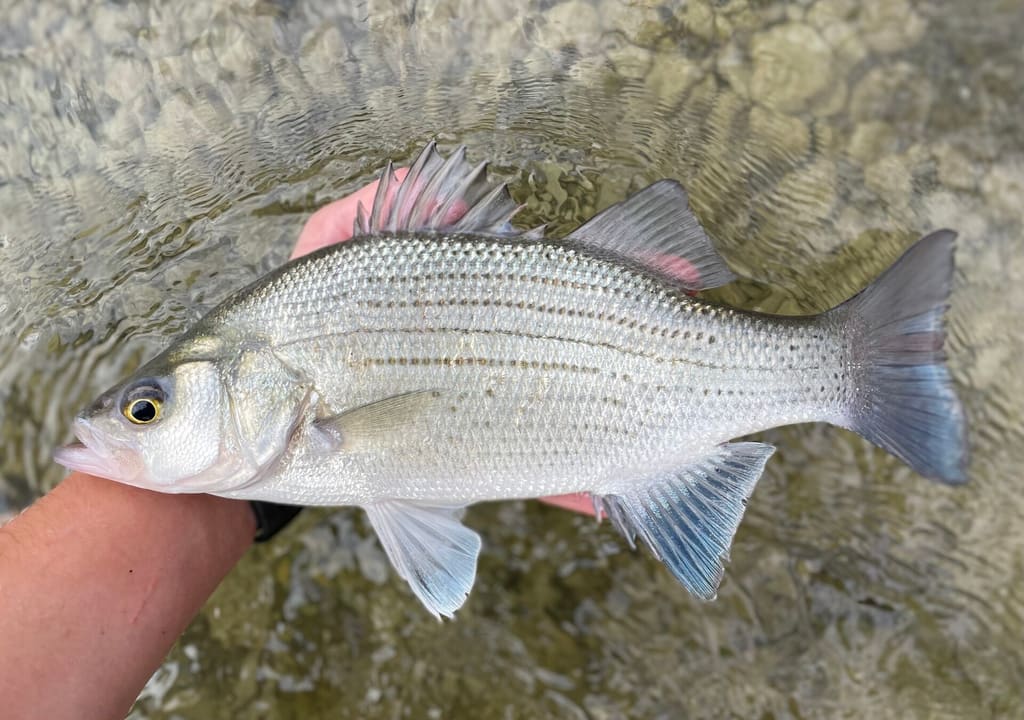
White bass belong to the temperate bass family, which makes them a relative of striped bass and not a relative of largemouth at all. They are silvery with a slightly greenish or golden back, deep-bodied and laterally compressed, with a series of dark horizontal stripes down the sides and two separated dorsal fins.
The confusion comes from striped bass and from the hatchery cross between the two, usually called a hybrid striped bass or “wiper.” All three can occupy the same reservoir, and in many states they carry different length and creel limits, so identifying them correctly is a practical concern, not a trivia question.
- White bass: Deep, compressed body. The stripes are relatively faint and broken, and typically only one stripe runs unbroken all the way to the tail. Inside the mouth there is a single tooth patch on the tongue. Adults are generally small, commonly well under three pounds.
- Striped bass: Long and comparatively slender, more torpedo-shaped. Stripes are sharp, dark, and several run clean and unbroken from behind the gill to the tail. Two distinct, parallel tooth patches on the tongue. Grow far larger than white bass. See our striped bass guide for more.
- Hybrid striped bass (wiper): Intermediate in shape, deeper than a striper but longer than a white bass. The giveaway is the striping, which is usually broken and noticeably offset, with stripes that appear to shift or step partway along the body. Tooth patches on the tongue are typically two, though they may sit close together.
Where White Bass Live
White bass are native to much of the central United States, particularly the Mississippi and Great Lakes drainages, and have been stocked well beyond that range. They are a reservoir and large river fish. You will find them in big impoundments, their feeder rivers, and the tailwaters below dams.
The key habitat requirement is open water with abundant baitfish, usually shad. White bass are pelagic pursuit predators. They do not sit in a brush pile waiting like a crappie does. They roam in schools through open water hunting bait, which is why finding them is mostly about finding bait.
The Spring River Run
This is the event white bass are famous for and the best window a bank angler gets all year.
As water warms in early spring, white bass leave the main lake and move up tributary rivers and creeks to spawn. The run generally begins as water climbs through the mid-50s Fahrenheit and peaks somewhere in the upper 50s to mid-60s, but the actual timing shifts by weeks depending on latitude and how the spring is running. In the southern part of their range it can start in February or March; further north it may be April or May.
Rather than trying to fish a calendar date, watch the water. If you have a way to check temperature, that plus recent rainfall tells you most of what you need. Rising, warming water pushes fish upstream. A hard cold snap stalls the run and pushes fish back down.
White bass do not build nests. They spawn as broadcast spawners over gravel, rock, and hard bottom, with fish scattering eggs in current. What that means for you is simple: the fish stack up wherever upstream movement is slowed or concentrated.
Target these places on a run:
- The first dam, low-head dam, or riffle a fish cannot pass
- Deep bends and holes where fish rest between pushes
- Current seams where fast water meets slack water
- The downstream edge of gravel bars
- Bridge pilings and any current break in the channel
Males typically arrive first and in bigger numbers, with larger females moving up later and often holding in slightly deeper water below the concentration of males. If you are catching nothing but small fish, try working the deeper water just downstream of the crowd.
Schooling Behavior and the Jumps
Once spawning ends, white bass drop back to the main lake and spend the rest of the year doing what they do best: hunting shad in open water.
They feed by driving schools of baitfish upward, trapping them against the surface. When that happens you get “the jumps,” a boiling patch of water where bass are slashing through bait and terrified shad are skipping across the top. Gulls and terns hovering over one area are the best long-range indicator there is. If birds are diving, fish are working.
Surface activity is most common early morning and in the last hour of daylight, and it is often brief. A school will boil for a couple of minutes, then vanish and reappear a hundred yards away. The mistake most anglers make is motoring directly at it, which puts the school down. Ease into casting range, shut off, and cast to the edge of the activity rather than the middle.
Even when nothing shows on top, the same fish are usually below, following bait at some depth. That is when a vertical or countdown presentation matters, and the same principles in our jigging techniques guide apply directly.
Best Lures
White bass eat baitfish, so nearly everything that works is a shad imitation. Keep it small. Match the size of the shad in the system, which often means lures in the one and a half to three inch range.
Small jigs. A one-eighth to three-eighths ounce jig head with a small swimbait, curly tail grub, or marabou body is the single most versatile white bass lure. White, chartreuse, and pearl cover most conditions. This is the primary river-run lure, cast upstream and worked back with the current.
Slab spoons and jigging spoons. A heavy flat spoon in the half to three-quarter ounce range drops fast, gets under a school, and can be ripped vertically. This is the go-to when fish are deep or when you need to punch through smaller fish on top to reach bigger ones below.
Blade baits. Thin metal vibrating baits are excellent for both the run and cold-water reservoir fishing. Lift and drop them, letting them fall on a semi-slack line. Most strikes come on the fall.
Inline spinners and small spinnerbaits. Good for covering shallow river water and for aggressive fish in stained conditions.
Topwater. When fish are actively jumping, a small walking bait, popper, or a shallow-running lipless crankbait is genuinely fun and effective. Keep it moving. White bass chase hard and rarely inspect a bait.
Casting spoons. A small silver spoon cast into a boil and retrieved steadily is about as simple as this fishing gets.
Reservoir Patterns Through Summer and Fall
After the run winds down, white bass distribution follows shad. In early summer they roam main-lake points, humps, flats near the channel, and the mouths of major creek arms.
As the water warms further and the lake stratifies, fish tend to hold in the cooler, oxygenated band above the thermocline and follow bait vertically. Sonar earns its money here, because a school of white bass over open water looks like exactly what it is: a dense cluster of marks stacked over or beside a bait ball.
Tailwaters below dams stay productive all summer. Moving, oxygenated water concentrates baitfish, and white bass sit in the current seams below generation flows.
Fall brings a second peak. Cooling water pushes shad toward the backs of creek arms, and white bass follow them in aggressive schools. Fall surface activity is often more sustained than in summer, and this is when many anglers catch their largest fish of the year.
Winter fish group tightly in deep water near the channel and feed slowly. Vertical spoons and blade baits worked with long pauses are the reliable approach.
Tackle
You do not need much. A medium-light spinning rod of about 6 to 7 feet with a fast tip, a 2500-size reel, and 8 to 10 pound line covers essentially all white bass fishing. Some anglers prefer braid with a fluorocarbon leader for better feel on a vertical spoon; our braided line guide covers the choices.
Light gear is genuinely more fun here. These fish pull hard for their size, and heavy tackle turns a memorable scrap into a formality.
Eating Quality
White bass are good to eat, and better than their reputation suggests, provided you handle two things.
First, bleed them and get them on ice immediately. The flesh is white and firm when fresh but degrades faster than a walleye or crappie fillet.
Second, remove the dark red lateral line meat when you fillet. That strip is where the strong flavor lives, and cutting it out changes the fish entirely. Trimmed white bass fillets are mild, flake nicely, and fry or bake well.
Because white bass are near the top of the food chain in many systems and can accumulate contaminants, check your state’s fish consumption advisories for the specific water body before eating a large number of them.
Common Questions
When exactly does the white bass run start?
It is driven by water temperature and flow rather than a fixed date. The run generally gets going as river water climbs through the mid-50s Fahrenheit and peaks in the upper 50s to mid-60s, which can mean late winter in the southern part of the range and mid-spring further north. Rising water from spring rain accelerates the movement, and a cold front will stall it. The practical approach is to start checking your local tributary a few weeks before you expect it, and to keep checking, because the run comes in waves over several weeks rather than all at once.
Can you catch white bass without a boat?
Yes, and the spring run is one of the best bank fishing opportunities in fresh water. Fish concentrate below dams, riffles, and other barriers in rivers you can wade or walk, and a small jig cast upstream and swung through the current is all the technique required. Tailwaters below reservoir dams also hold fish from the bank through much of the year. Summer open-water schooling is genuinely harder without a boat, though windblown points and jetties on big reservoirs sometimes put breaking fish within casting distance.
Are white bass and hybrid stripers the same fish?
No. A hybrid striped bass, often called a wiper, is a hatchery cross between a white bass and a striped bass, stocked in many reservoirs to create a hard-fighting open-water predator. Hybrids grow considerably larger than pure white bass and are usually identified by stripes that are broken and clearly offset partway along the body, plus a body shape between the two parents. Many states set different size and creel limits for white bass, hybrids, and stripers, so confirm your identification before keeping fish.
Final Thoughts
White bass are the answer when you want to catch fish rather than wait for one. Time the spring run in your local river, learn to read the birds on your local reservoir in summer and fall, and keep a handful of small jigs, a couple of spoons, and a blade bait in a box that never leaves the truck.
They will not be the biggest fish you catch this year. On the right morning, they will be the most.